Crawl Space Encapsulation Cost: Compare the Full Scope
Crawl space encapsulation cost depends on what the contractor includes, not just the floor area. A liner-only installation, a sealed enclosure with humidity control, and a project requiring drainage or structural repairs are different purchases. Compare an itemized scope before treating a quoted total or price per square foot as a meaningful benchmark.
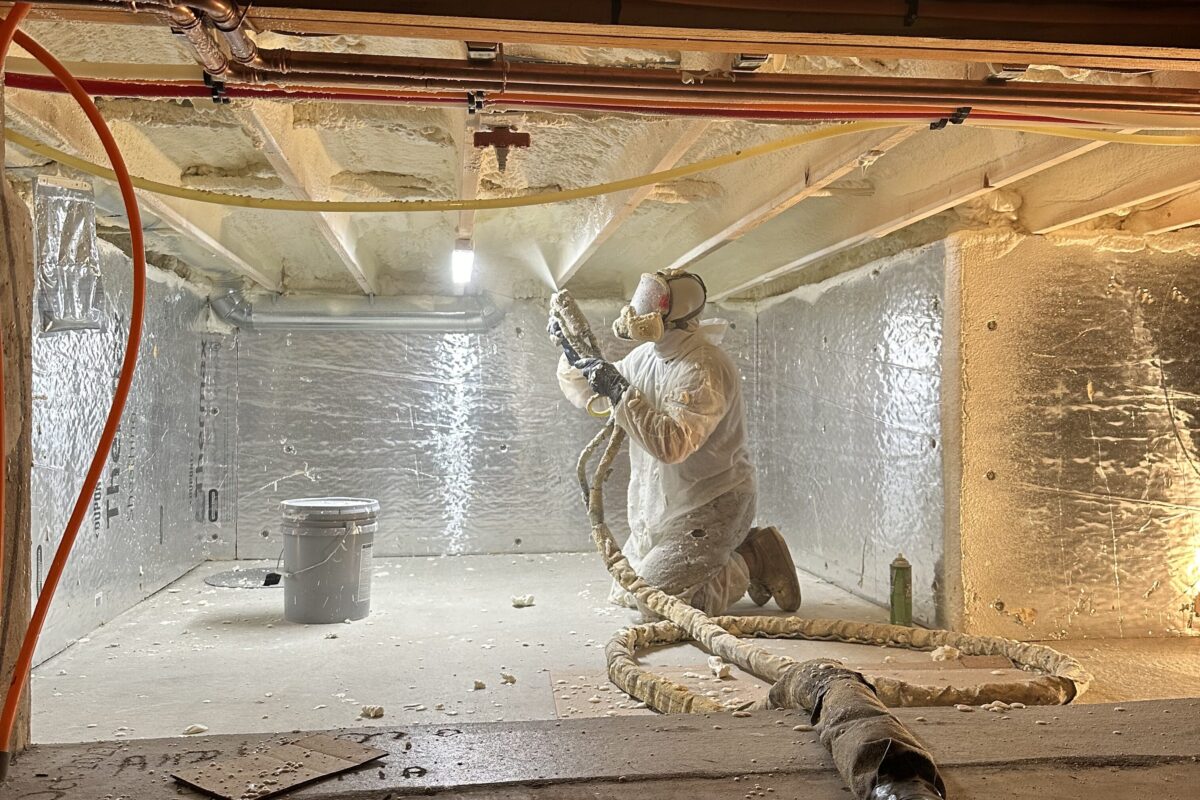
For regional context, Idaho Drainage Solutions publishes an $8,000–$14,000 range for full encapsulation with a dehumidifier in its Boise-area guide. Its broader projects with dedicated sump drainage and insulation run higher. These are that provider’s regional planning figures—not a national average, an independent price survey or a quotation for your house.
This guide helps you understand the difference and prepare comparable proposals. If your project starts with standing water, investigate the water-entry path and drainage before assuming encapsulation is the first purchase.
What should an encapsulation quote cover?
The word “encapsulation” is used for packages with different boundaries. Ask what will actually be covered, sealed, insulated, repaired and mechanically controlled. A clean white liner photograph does not tell you whether the contractor included drainage, a drying strategy or preparation of damaged material.
| Scope line | Ask the contractor to identify | Why quotes differ |
|---|---|---|
| Assessment and preparation | Water sources, access, cleanup and material condition | An empty dry site is different from a damaged one |
| Drainage and liquid water | Entry-path correction, collection and discharge | Site water problems can dominate the work |
| Ground and wall membrane | Product, coverage, seams, piers and terminations | Roll thickness alone does not define the completed system |
| Air and thermal boundary | Vents, access door, perimeter details and insulation | Climate and the approved design change the specification |
| Humidity control | Drying method, equipment, drain and electrical scope | Some offers omit equipment or installation trades |
| Verification and upkeep | Photographs, readings, testing and maintenance | Completion and future responsibilities may be unclear |
Use regional prices as context, not a promise
The Boise contractor’s pricing guide separates basic vapor-barrier installation, a middle scope including vent sealing and minor drainage, full encapsulation with a dehumidifier, and larger drainage/insulation projects. That separation is more useful than applying one cheap starting price to every home.
For example, its published middle-scope range is $3,500–$7,500, while its fuller package is $8,000–$14,000. Projects including dedicated drainage and insulation are described at $12,000–$18,000 or more. The figures overlap because actual site conditions and scope matter. They should not be combined into a national “typical price.”
Your location, access, quantities and needed repairs can differ substantially. Ask local qualified providers to price the same specification. Date the proposals and note how long each offer remains valid, particularly when materials, equipment or disposal are priced separately.
Separate repairs from the enclosure itself
Active plumbing leaks, recurring runoff, rotted framing and contaminated material require their own assessment and repair plan. Hiding them under a new liner can make a finished project look better while leaving the source unresolved. PNNL’s pre-retrofit assessment guidance explains why site conditions belong early in the process.
If a proposal includes repairs, request quantities and assumptions: which area, what material, what removal, and what happens if additional damage is exposed? An allowance is not the same as an unlimited fixed-price commitment. Ask how variations are approved before the contractor proceeds.
For odor-related projects, organize the evidence around the source of the smell. A smell does not specify a remediation scope or justify replacing every material beneath the house. The contractor should connect the proposed work to observed conditions.
Compare liner materials as a complete installed system
Our vapor barrier buying guide explains why permeance, strength information, compatible accessories and layout belong beside thickness. Ask whether wall and pier work is included and how penetrations, seams, access paths and future repairs will be handled.
If one quote specifies a roll brand and another says only “heavy plastic,” request clarification before comparing them. Likewise, a higher nominal thickness does not automatically justify any price increase. The finished detail and the published material properties need to support the choice.
DIY material prices cover a narrower purchase than a professional enclosure. A roll-price comparison can overlook preparation, compatible accessories, equipment and the work needed to detail seams, walls and piers. Include those items and the value of your own safe access and labor when comparing options.
Understand the humidity-control line
A dehumidifier package should identify the exact model, capacity basis, controls, supports, drain route and electrical work. Some quotes include the machine but assume an outlet and drain already exist. Others include a complete commissioned installation. Those are not directly comparable totals.
Separate the equipment, drainage, electrical work and labor in the dehumidifier installation budget. If you are choosing equipment yourself, our documented model comparison describes the fit and ownership questions. Ask whether the chosen drying method is appropriate for the locally approved enclosure design, rather than assuming every project requires the same appliance.
The finished system also needs a way to verify conditions away from the machine. Our humidity guide explains how representative measurements support follow-up. A low reading taken directly beside the outlet should not be the sole acceptance criterion for the whole crawl space.
A quote worksheet that exposes scope differences
Imagine two hypothetical proposals: A totals $9,000 and B totals $11,000. If A excludes drainage, electrical work and disposal while B includes them, the totals do not establish which offer is better value. List the omitted items and obtain actual costs before making the comparison.
The same applies to warranties. Ask whether a warranty covers materials, workmanship, equipment and repeat water entry, and what maintenance or exclusions apply. A warranty on a liner is not automatically a guarantee that no water, odor or equipment problem can occur.
This example contains assumed totals for comparison only. It is not a project we completed, a recommendation to pay either price, or evidence that an extra $2,000 is justified. Its purpose is to make the missing scope visible.
Before approving a contractor
- Obtain an itemized specification, quantities, exclusions and change-order process.
- Check the appropriate local credentials, insurance and references for the work.
- Ask who handles permits, electrical work, soil-gas issues and specialist repairs.
- Confirm protection of required inspection access and any flood-related provisions.
- Agree on completion records and how performance will be reviewed.
- Read payment milestones, maintenance obligations and warranty terms before signing.
Is a price per square foot useful?
It can help compare similar scopes with consistent measurement rules. It is less useful when one project includes major fixed-cost equipment or repairs and another does not. Ask whether the area refers only to the floor or also to wall coverage and how the quote accounts for obstructions and access.
Will encapsulation pay for itself through energy savings?
Do not assume a universal payback period. Energy use, climate, the previous condition and the actual scope all affect the result. Evaluate the project primarily against the diagnosed moisture and building needs; treat savings projections as estimates with stated assumptions, not guaranteed cash flow.
What if the budget only covers part of the work?
Ask the assessor to identify a safe, coherent sequence that addresses the most consequential water or material problems first. A cheaper partial scope should have an explicit purpose and limits. Avoid assuming that the visible liner portion is automatically the best first stage of every project.